| Property | Revenue | Operating margin |
|---|---|---|
| Property 1 | $103K | 54% |
| Property 2 | $130K | 51% |
| Property 3 | $69K | 66% |
| Property 4 | $117K | 49% |
We're Viktor and Meghan. We built the House Of portfolio — the four short-term rentals in that table (we sold one in 2026) — and run it from wherever we happen to be. No property manager. A local crew handles the physical work. A $460/month software stack handles the remote work that full management charges thousands each month to do.
We wrote the whole system down. It's called The Invisible Host, and it's available now.

One November night, the noise sensor at one of our houses went off at 2am. We were living in Los Angeles, two hours from the desert. We called, texted, messaged through Airbnb. Nothing.
So Meghan got in the car. By the time she arrived, around 4am, the guests were asleep and there was nothing to confront. She slept in the car outside our own house and drove home in the morning.
Everything we've built since exists so that nobody sleeps in that car again. Today the same alert sends the guest a polite message before the noise becomes a party, and most of the time that's the end of it. The Invisible Host is that system, written down.
Adapted from The Invisible Host — System Card 08 of 10: The Guest Playbook. When a guest wants money back: find your situation, make the move, close the app.
| Situation | The move |
|---|---|
| It's broken and it's our fault (the propane that ran out mid-winter-storm) | Refund the affected nights before they ask twice. Then fix the system so it can't happen again. |
| Nothing's wrong — guest is fishing for a discount | One polite no, in writing, on the platform. The customer is not, in fact, always right. |
| Platform gaming (the toenail) | Document everything. Stand your ground. We lost $2,500 to a toenail "found" in a freshly made bed. Timestamped turnover photos win most of these; that one, they didn't. |
| Party or rule break (the film crew rager) | No refund. Document, file the claim, move on. |
Every section ends in a card like this. The story is how you understand the rule. The card is so you never have to re-read the story at 11pm while a guest is typing.
This is one page. There are ten cards like it.
You've Googled "how to start an Airbnb without it becoming a second job." You've seen the $3K–$7K courses. You don't need a coach. You need to see how a real operation runs — line items, message templates, the boring middle.
Ten to twenty hours a week of guest messages, cleaner texts, pricing tweaks. Roughly $460/month of software handles the remote work that full property management would charge thousands each month to do. Ours handled four properties. Yours would handle two with room to spare.


Three of the four houses in that table, still running on the system. (The fourth sold in 2026.) Which house earned what stays in the book, so our guests never have to read our P&L.
— the part nobody publishes:
One property's nightly rate compressed from $707 to $440 as the market matured — and we still run 49–66% margins at today's rates. That's the point of a system instead of a hot market. A propane tank ran dry in a winter storm and earned our first 1-star — out of 650+ reviews. Fourteen rejected offers before anyone said yes to us. We bought a $21,500 Airstream the county never let us rent.
The failures are the product. Anyone selling this business without the scars hasn't run it.
| The STR course industrial complex | The Invisible Host |
|---|---|
| $49 launch price | |
| Revenue screenshots, expenses cropped out | Our actual 2025 P&L, pulled from QuickBooks |
| A webinar, a "strategy call," a closer | A checkout page. That's the entire funnel. |
| "Financial freedom" | A 54% operating margin in 2025, and the time Meghan slept in her car |

One payment. Lifetime updates — when the market changes, the cards change, and you get the new ones. 7-day money-back guarantee, no questions.


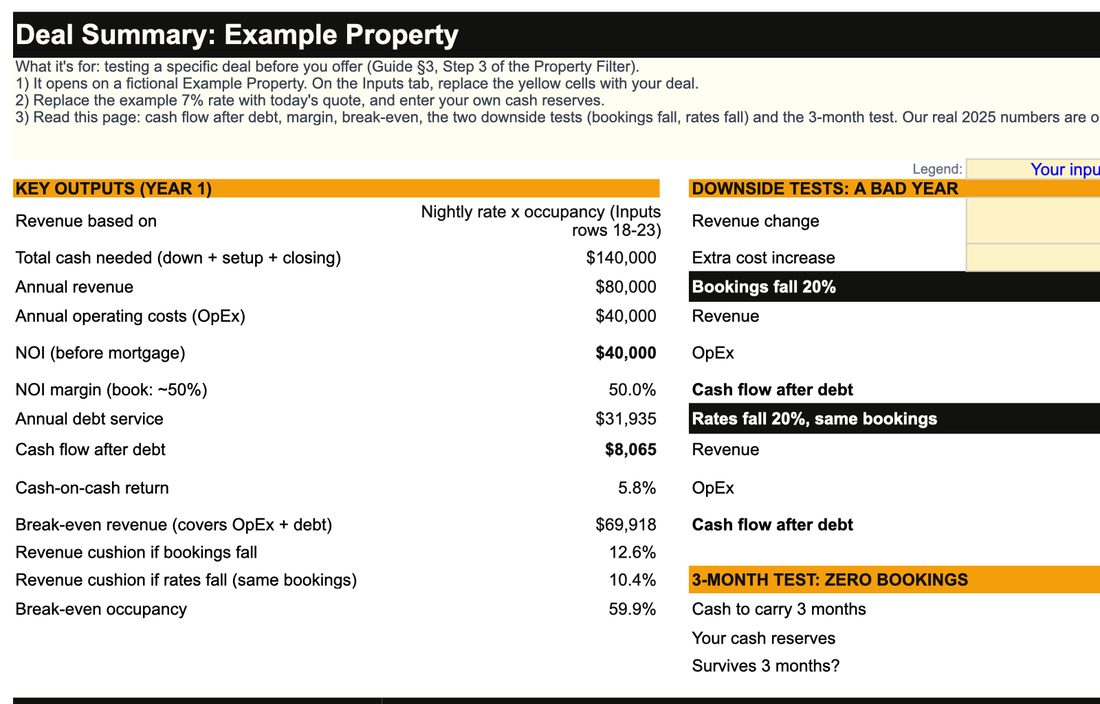
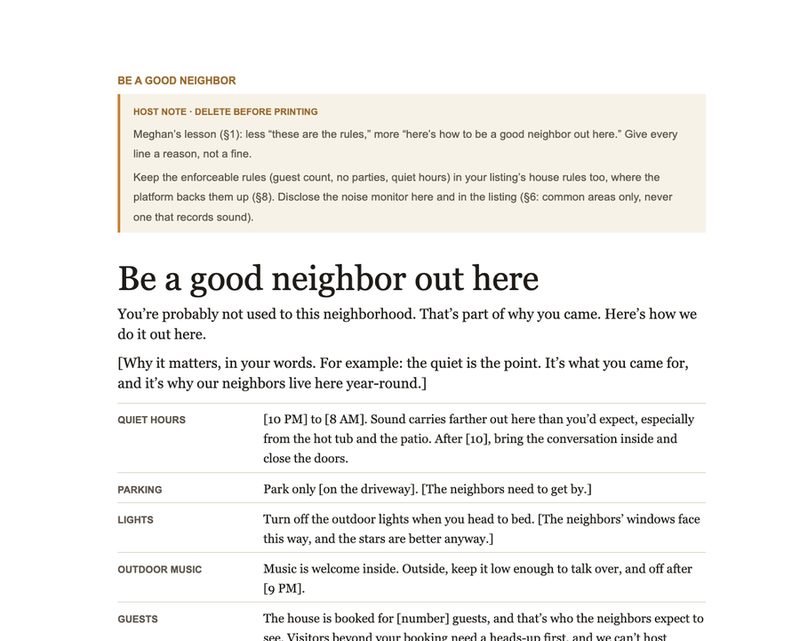
One download: the guide as a PDF of about 120 pages, six workbooks (Excel or Google Sheets) and three kits (Word or Google Docs, plus plain text). It's in your Gumroad library the moment you pay.
Our stories are Californian; the system isn't. There's a checklist for reading your own city's or county's rules, and the messages, pricing, crew, guests and money work anywhere Airbnb does. In Canada? Everything about running the houses applies; the tax and lending chapters are US-specific.
No. There's a one-listing path: what to read, what to skip, and what the software costs at your size, starting at $0 a month.
Start with the first-time buyer path: the market test, a full first-property budget, financing explained honestly, and a deal calculator that tells you when to walk away.
No. It's our story and our real numbers. We're hosts, not licensed professionals. The tax chapter is written so you can have a better conversation with a CPA, not replace one.
Reply to your receipt within 7 days for a full refund. No questions.
No. Every update is free, for life, in the same Gumroad library.
Not sure? Take the free 7-page preview: our revenue year by year, the $21,500 mistake, the four guardrails we run every property through, and what the 15-minute week looks like. Read it tonight, then decide if $49 is fair.
If you're skeptical, good. So were we. If the numbers at the top of this page didn't convince you, the preview won't either, and that's fine. We'd rather lose you now than refund you later.
The free preview asks for an email — that's the whole price. No drip sequence pretending to be your friend. Unsubscribe anytime.— Viktor & Meghan Engborg, House Of